Sunday, June 20, 2010

Dear Dad

Dear Dad:

It's Father's Day in the USA
I ought to give you a tie today
But though it might have been good form
Instead I'll deviate from the norm
And send a better gift your way

I've spent most of my career
Trying to get back to, or at least near
Friends, Family, and where I call home
Twelve years of paperwork amounts to a tome
But it's finally paid off, so I hear

For although I haven't yet got a date
It might not be much longer to wait
Grab your hat, get your boots on
Watch out y'all - I'm moving to Houston!
I guess good things do come to those who wait

Happy Father's Day

Love,
Your son

Friday, June 18, 2010

COA + UAL


In early May, Continental Airlines and United Airlines announced plans for a merger that would once again make United the nation's largest airline, a position I believe it held until dethroned by the Delta-Northwest merger. While regulatory approval is expected, it has yet to come to pass. As you might expect, there's a certain amount of opposition from cities/states who fear losing jobs, unions representing flight attendants and pilots, and consumer groups and government regulators who see reduced competition and higher prices.

At LAX, Continental and United already share Terminal 6, so no big change will be required there (unlike Delta and Northwest, who were on opposite sides of the airport). While LAX is a United hub, for Continental it's a destination served by flights from its hubs in Newark, Cleveland, and Houston. United also flies from here to Newark, but the only other destination duplication the two carriers have at LAX will be Honolulu and Maui, Hawaii. United flies B757's and B767's between LA and Hawaii, while Continental was the first carrier to use B737's from here to the islands. With such minor overlap, it seems likely that LAX will see only a slight net decrease in flights as a result of the merger. I've heard that Continental's headquarters in Houston will be moved to United's offices in Chicago, but flights out of Continental's Houston hub are expected to increase.

A United A319 departing runway 25 right as a Skywest E120 waits between the runways.

Continental's turn to wait, while a Skywest CRJ7 taxis in.

Continental's anniversary livery on a B737-900. The Continental in the previous shot is a B737-800. If United has any special paint schemes, I haven't seen them (not counting the Star Alliance livery, of which Continental and United both have examples)

Monday, June 14, 2010

Flag Day Odds and Ends

Today is Flag Day in the United States, a day that commemorates the anniversary of the Second Continental Congress' adoption of what became the US flag on this date in 1777. So fly your stars and stripes!

The last couple of my work weeks have both ended with mid-shifts that featured more than the usual amount of unusual things taking place. We've have earthquakes that were felt in the tower, aborted takeoffs, debris on runways and taxiways, blown tires, hot brakes, lost pilots, befuddled trainees, and confused tug drivers. All in a day's (well, night's) work, but enough to make it memorable for a little while.

Meanwhile, in some recent entries I've mentioned the return of seasonal operators at LAX. Memorial Day weekend is the opening of the summer travel season, and besides carriers that show up for the summer, we also see an expansion of destinations offered and larger equipment used.

For example, I've recently noticed Southwest now going from LAX to St. Louis, a route previously served only by American. Southwest has also started service between LAX and Baltimore-Washington, which is also flown by AirTran and United.

United has added flights to Bozeman, Montana, and Jackson Hole, Wyoming. Jackson Hole has been an occasional ski destination before, but Bozeman is new. I've also seen B757's introduced on the weekend flights to New Orleans, a route United normally covers with A320's, so I guess more folks are heading down to the Big Easy again. Who dat?!

Delta has just started flights from LAX to Hartford, CT, a route not previously served by anyone within recent memory. They're using B737-800's for the four and a half hour flight. Delta has also chosen to jump into the crowded pool of carriers flying to San Francisco - we've already got five other passenger carriers covering that route. I think we've got more carriers going between LAX and SFO than any other destination: Besides the six major passenger carriers, we've got that many more cargo operators as well. In other Delta news, a while back I mentioned that the MD-90's had been replaced by Skywest CRJ's on the Salt Lake City route; I've since seen them a few times going to Minneapolis-St. Paul, a former Northwest destination from LAX. Meanwhile, former Northwest A320's are now serving the Delta hub in Cincinnati. The former Northwest A330-200's have also returned on the Tokyo run.

For unlikely destinations, Allegiant is the one to watch. They've just started flights to Idaho Falls, ID, and Pasco, Washington. At the moment, I don't think Allegiant has any routes at LAX in competition with anyone else; everywhere they go from here, they're the only way to get there.

And Alitalia has returned to LAX after over a year's hiatus, offering our only direct service to Rome, Italy. This eleven-hour flight is served with a B777-200, and was greeted by a welcoming spray from the fire department on their first arrival last weekend.

Air Canada has recently shown up with B767-300's on one of the Toronto flights. This route is normally covered with some model of Airbus (A319, A320, or A321).

And that reminded me of something we haven't seen lately: Air Canada Jazz. I don't recall when I last saw a Jazz plane here, but it's been some months now. Jazz only went from here to Edmonton, a route that mainline Air Canada also serves with E190's. WestJet also flies to Edmonton, using B737's. Although I haven't been counting, WestJet does seem to be increasing its presence at LAX lately, with service to Calgary and Vancouver in addition to Edmonton.

Unfinished business:

On my airport tour, I showed you a pair of Qantas B747's inside a hangar. This is the normal tower view of that hangar, seen over the top of the international terminal. In this view, we're seeing the opposite side, which has much lower doors and roof. Although I don't know if the super will actually fit inside, this building is large enough to completely hide an A380 from the tower.

A comment posted to my previous entry questioned the placement of the RWSL lights in the runway. LAX's RWSL system has two components: Runway Entrance Lights, which are installed on taxiways that enter or intersect the runway; and Takeoff Hold Lights, which are installed along the runway centerline. The THL's are what were shown in the photo last time. I borrowed this graphic from MIT's Lincoln Laboratory:
http://rwsl.ll.mit.edu/Image-Lib/op-concept-lrg.jpg


The onset of June gloom has apparently brought with it summer cold season, as I've had draining sinuses and a sore throat for well over a week now. Enough already!

Thursday, June 10, 2010

Airport Tour


I was assigned a new controller trainee a couple of weeks ago. Part of the training process is a ground-level tour of the airport, conducted by one of the airport operations folks. We usually wait until the new controller has started training on ground control before we do this, as it will make more sense to them that way. The reason for taking them on the tour is that it gives them a chance to see the airport from the pilots' perspective, which is entirely different from that of the controllers in the tower. What makes perfect sense to a controller looking down on the airport can be utterly confusing to a pilot looking out the cockpit windows. Taking an airport tour helps controllers understand that, which in turn can help us do a better job formulating instructions for the pilots. This is especially because as a controller, I only work at one airport; most pilots fly from one airport to another, and often do that several times in the course of their day. I've had visiting pilots tell me that they have days that take them through half a dozen different airports.

Besides the training value, the tour also gives me a chance to take some pictures from a completely different angle:

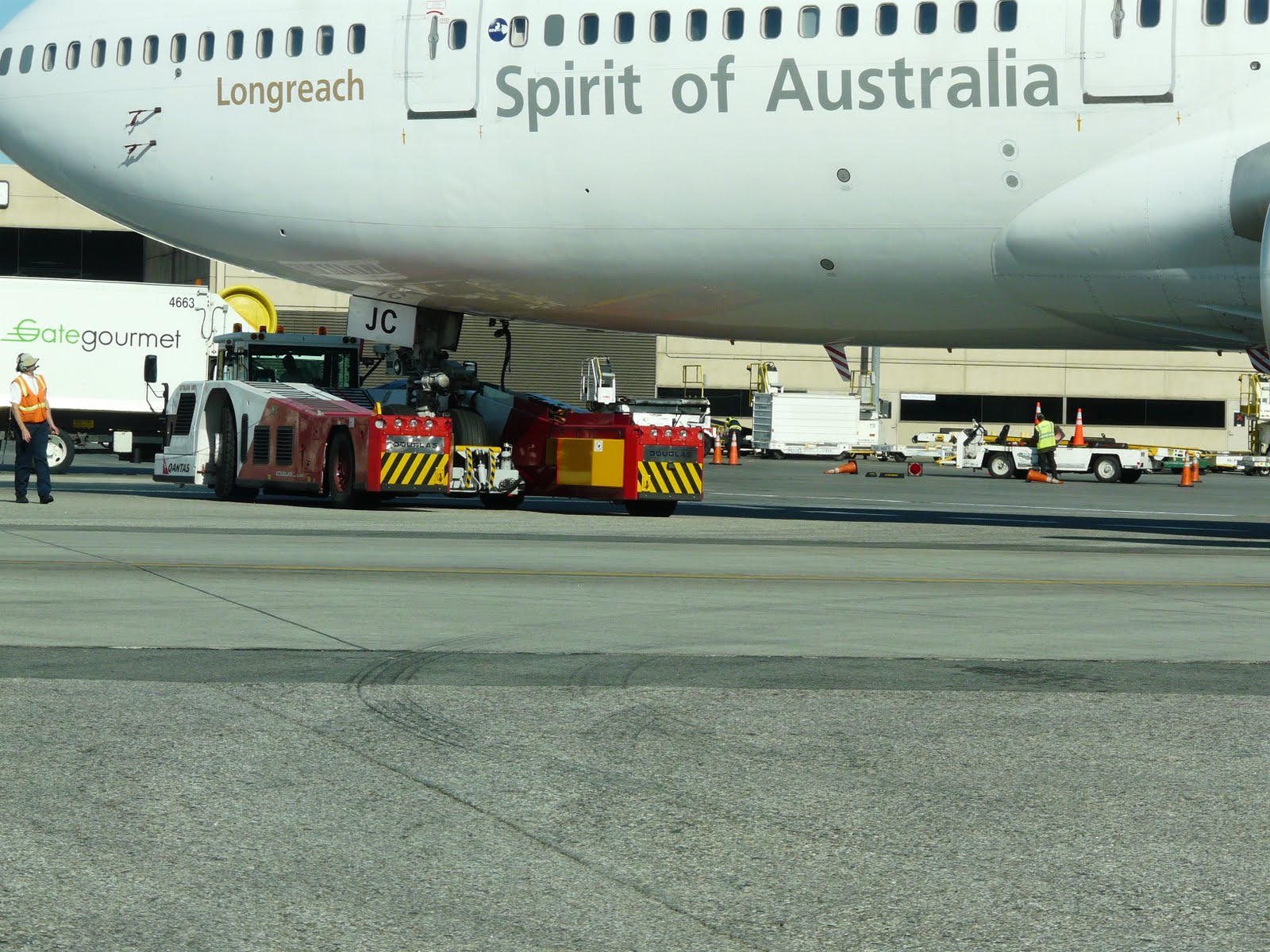
I've shown you super tugs before, but this is what one looks like from the front seat of your average car. It says Douglas on the front, but as far as I know that's no relation to the former US aircraft company; these are built by the British firm Douglas-Kalmar. This example is the largest model, capable of handling the Airbus 380. Fully loaded, the A380 can weigh 1.2 million pounds; the tug itself only weighs about 75,000 pounds. James Bond fans may recall seeing Bond drive one of these in the 2006 movie Casino Royale (I'm going to have to go watch that one again!)

Here's a super tug (also known as a towbarless tractor) in action, pushing a Qantas B747 off a gate at the international terminal.

In comparison, here is a more typical pushback tractor, which uses a towbar to connect the tug to the aircraft's nosegear. Pushing an aircraft backwards with one of these is approximately like backing a trailer with your car. I use a little Clarkat to push the Baron into its hangar, and it's not easy to get everything lined up and keep it that way as the plane goes through the door. It's possible to get the rig jack-knifed just like an 18-wheeler, and a broken towbar is the least damaging result you can hope for. This happens at LAX at least once a week, and everything stops while the towbar gets repaired or replaced. Thus, controllers like the super tugs: No broken towbars!

Here's a south-looking view of our brand-new Taxiway Romeo, which had been open for less than a week when I took this shot. You can tell that this is a taxiway by the color of the centerline: Yellow for taxiways, white for runways (at night, the edge lighting is also color-coded: blue for taxiways, white for runways). The big hangar is American Airlines maintenance, while the Coast Guard station is on the right. The brown building just past the Coast Guard is to be the new fire station. That hill in the background is Palos Verdes.

Here, we're on the east end of Runway 24 Left, looking towards the beach. Notice the white center stripe. Also observe the heavy jet in the distance; that's a Delta B747 that just arrived from Tokyo on the parallel runway (24 Right) and is now on Taxiway AA and about to cross our runway. As you can see, the runway isn't flat; this end is lower than the west end. The runway is also crowned, just like a road, with the center being higher than the edges.

Same runway, a few seconds later. We're now a few hundred feet from where the previous shot was taken, at a speed of about 45 mph. The Delta B744 is crossing the runway about a mile and a half in front of us. Notice the red lights on each side of the runway centerline; these are Runway Status Lights (aka RWSL's), one of our newest pieces of safety equipment at LAX. They're tied into our ground radar and automatically come one when the system detects that the runway is not safe to land or take off. Similar lights are installed at some taxiway intersections; their purpose is to indicate when it is not safe to cross a runway.

Another view as we drive down the runway. We are now nearly 2,000 feet down the runway. If you look on the left and right sides of the runway, you can see black signs with a white "8" on them, signifying that there are 8,000 feet remaining to the end of the runway. Look at how black the concrete is here; that's rubber from the tires of landing airplanes. On our primary arrival runways, it gets so bad that the airport has to repaint the center stripes on a weekly basis, and periodically they'll have to close a runway for rubber removal. I read somewhere that airliner tires sometimes have to be replaced after 100 landings, and no wonder!

Here's another taxiway shot. Well actually, an ex-taxiway shot. This was, until a week or so ago, Taxiway Q, which ran behind the international terminal, which is the building on the right. As part of the project to install gates on the west side of the international terminal, Taxiway Q has now been permanently closed. We can't see this side of the international terminal from the tower, and it was possible to lose sight of smaller aircraft when they were on Taxiway Q.

A pair of C-5A Galaxy's parked at the west end of the airport, in the remote gate area.

A couple more big planes . . . indoors! A pair of Qantas B747's getting serviced after their early-morning arrivals. They'll spend the day on the ground at LAX before leaving late in the evening.

You've seen the DC-3 parked at the museum on the south side of the field in the background of many shots; here's a shot of the cockpit.

And here we see the tower and the Theme building, as seen from beneath the nose of the DC-3. The building that appears to be the base of the tower is actually Terminal 5.
Not so easy to see: the two runways and four taxiways between here and there!


Resources

If you'd like some more about the super tugs, try these articles:

Car and Driver magazine


BBC's Top Gear


For more about the Flight Path Museum at LAX:

http://www.flightpath.us/