Showing posts with label A340. Show all posts

Monday, January 19, 2015

Yet another B777


China Eastern is the latest carrier to operate the B777 at LAX. Not only is it a new airplane, it's wearing a new livery with a new version of the swallow. A reader alerted me to the coming of the first one this past Thursday. I didn't catch the arrival, but here it is on its way out to Shanghai.


The B777 has nearly as many seats (316) as the A346 it replaces (322). China Eastern only had five of the big Airbuses, but plans to acquire twenty B777s. Unlike the B777, which is becoming ubiquitous at LAX, we don't see that many A340-600s. China Eastern only brought in one per day; we still see one each from Lufthansa and Virgin Atlantic; and during the summer months we sometimes have another from Iberia. 


The China Eastern A346s actually left the LAX scene last year; in the interim China Eastern has been using A330-200s on the Shanghai - Los Angeles route. For a time, we were getting two per day:


Friday, July 18, 2014

More Eurowhite


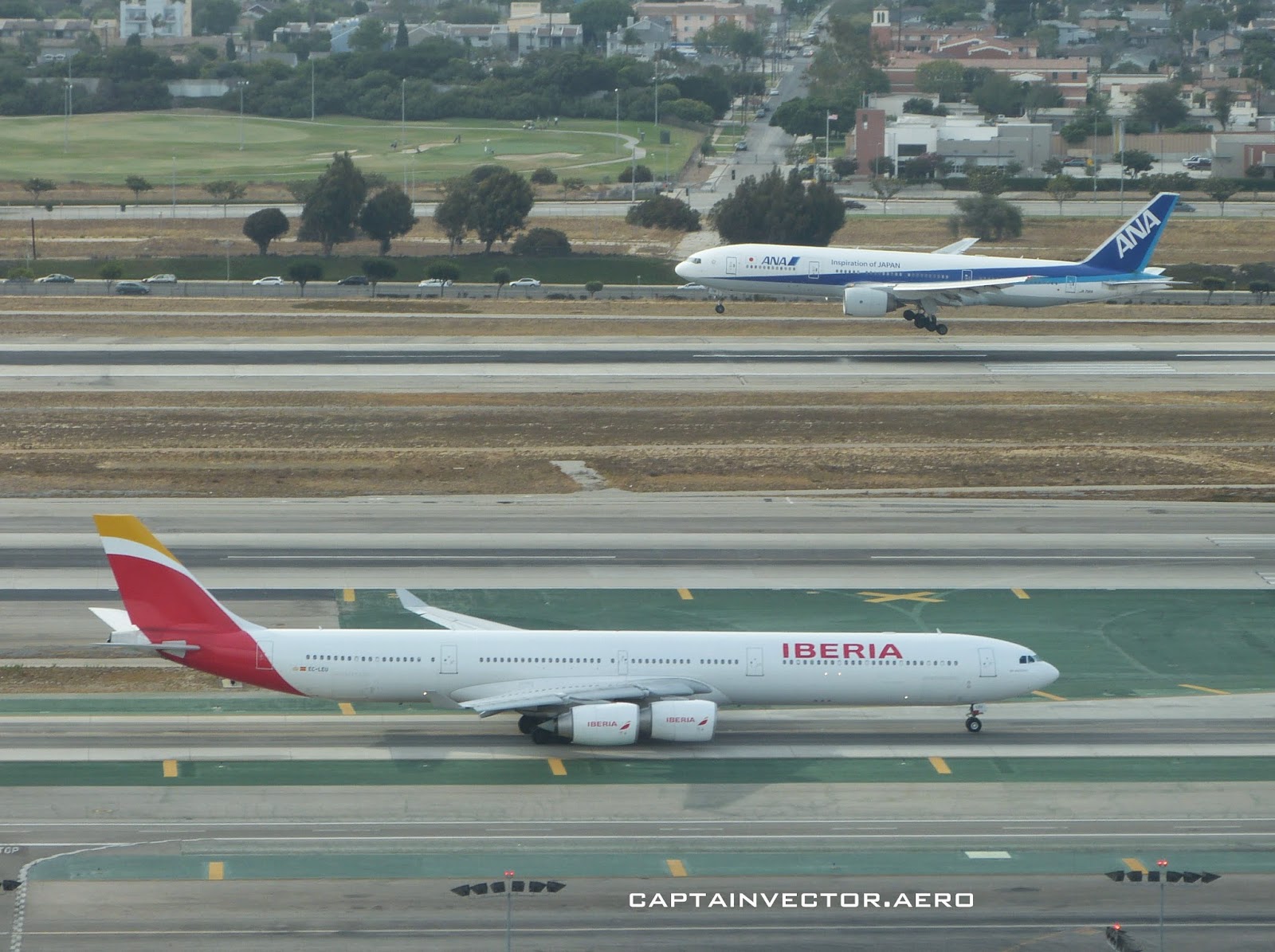
After my post from earlier this month, one might suppose that I don't like the current trend of airline liveries. But as always, there's the exception that proves the rule, and this is it. Above and immediately below are Iberia's new colors on an A340-600. I apologize for the poor photos, but you get the idea.


And now, take a look at the livery that is being replaced by what you've seen above:


A definite improvement, wouldn't you say? Meanwhile, from the department of Just Because, another shot of the new Air New Zealand livery, this time modeled on a B777-200, which we don't see very often at LAX in New Zealand colors:


Monday, June 3, 2013

Shot of the day quiz revealed: LAX A340 family photo


Wow - apparently it was a slow weekend out there in the blogosphere. Lots of you chimed in with comments about this shot, and a number of you nailed it. Several others called out various things I hadn't noticed, so shout outs to you all.

As most of you observed, this photo features three A340s. What I thought was noteworthy about this shot was that it featured all three variants of the Airbus A340 which can regularly be seen at LAX. Namely the A340-300, -500, and -600.  No scheduled carriers bring A340-200s to LAX, although I have seen one here a few times.

Of the three models that we see daily at LAX, the A340-300 is by far the most numerous. Modeled here by Swiss, we also receive A343s from Iberia, Phillipines, and Air Tahiti. Previous A343 operators at LAX include Air France, Lufthansa, LAN, and Virgin Atlantic.

The A340-500 is the rarest of the three variants seen at LAX; less than three dozen were built, and only one carrier still operates them here: Singapore, who has five of them and operates (for a few more months, anyway) the A345 on the longest scheduled routes in the world. The Newark-Singapore route is the longest, followed by LAX-Singapore. Singapore has configured their A345s for 100 passengers (no coach seating), but will be trading their A345 fleet to Airbus as part of a deal to acquire more A380s and A350s. I've seen speculation that Singapore has been losing money on these routes for some time, as the price of fuel has escalated greatly over the last five years. The -500 has the longest range of any of the A340 models; it can fly 9,000 nautical miles (17,000 km), and in order to do that it has a fuel capacity of 59,000 U.S. gallons (222,000 litres). Singapore has said that they're retiring the A345s in accordance with their "young fleet" policy; their A345 fleet is now approaching ten years of age. The only other operator to bring A345s to LAX was Thai, who had four and operated theirs between LAX and Bangkok, a route that I believe was a bit longer than the LAX-Singapore route. Thai's A345s disappeared from LAX last year, replaced by B772s and B773s. The nonstop service to Bangkok went away at the same time; Thai's Boeings now go to Seoul, South Korea, before continuing on to Bangkok. In the same vein as the Singapore speculation, I read somewhere that Thai would have needed to operate their A345s at 120-percent capacity in order to break even on the LAX-Bangkok and similar routes. I suspect that both the Bangkok and Singapore to Los Angeles nonstops were maintained for the prestige of offering the only direct service between those city pairs, but prestigious does not equate to economically viable. I don't know what became of Thai's A345s, but I imagine that Airbus may have some difficulty reselling the ones they're taking in from Singapore, as the A345 is a really niche aircraft, built for really long routes. Emirates operates the world's largest fleet of A340-500s; they have ten, but we don't see them at LAX. I'll be sorry to see the A345s leave; at LAX the -500 is our favorite A340 variant. The big Rolls Royce Trent engines that it shares with the -600 make it a much better performer than the -300, but it doesn't pose all the complications on the ground that we face with the longer -600.

Lufthansa is one of four A340-600 operators at LAX; the others are China Eastern, Iberia, and Virgin Atlantic. Thai also has been seen here in an A346, although I can only recall it happening once or twice; it was not a regular thing. Until the introduction of the Boeing B747-8, the A340-600 was the longest airliner in the world. I've previously detailed the problems that the A346 creates for controllers at LAX, so I won't belabor that point further, except to say that we're glad that there aren't more of them.

Monday, October 6, 2008

Where can we go from here?

One of the neat things about LAX is the wide variety of destinations with direct service. These days, it's possible to get from almost anywhere to nearly anywhere else via the hub and spoke airline connection systems, but direct service is not always so easy to come by. If you're in a city that serves as some airline's hub, i.e. Atlanta (Delta and AirTran), Dallas (American), or Houston (Continental), then you're in good shape. If you're not in one of these places, the first leg of your journey will be to one of them, where you can then get on another airplane that will hopefully take you where you want to go. LAX does serve as a hub for United, American, and Alaska, and thus we have many options with those carriers. Southwest also has a major presence here, as does Delta. Not surprisingly, foreign airlines also have strong availability: Air Canada, Aero Mexico, and Mexicana all have many flights out of L.A. each day.

Many other airlines, foreign and domestic, have limited service from L.A., usually to their respective capitals or hubs. At this writing, there is direct service from L.A. to destinations on five of the seven continents of the world. Currently, we have no direct flights to Antarctica nor Africa. Egypt Air used to serve the latter, but they haven't flown out of L.A. for some time now. Even with at least fifty airlines operating here, not all destinations are served daily; some are only two or three times a week (Moscow and Dublin come to mind).

It's taken me several weeks to compile a list of destinations, airlines, and flight times; even so, it may well not be complete. If I'd done it in August, there would be at least a dozen more destinations than what are now available. Presentation is the problem: I don't want to just paste a great big table or list of destinations here, as that would be pretty clunky. So instead, I'll just hit various interesting highlights as they occur to me:

Shortest and Longest:

The shortest scheduled flight out of LAX is twelve minutes: Skywest flies non-stop to Oxnard, which is just up the coast from the LA area. Thanks to where Skywest parks on the airport, it can sometimes take this flight longer to get to the runway than it does to get to its destination once airborne.

The longest scheduled flight out of LAX is the Singapore Airlines flight to Singapore, which in the summer takes about sixteen and a half hours. In the winter time, I've seen it run closer to eighteen. At present, no one else makes this run out of LA, and Singapore does it with the Airbus A340-500, seen here arriving on runway 24 right. The A345 has the big engines of the A346, but without the extra-long fuselage. Thai also brings A345's into LAX, on the next-longest flight, to Bangkok, which usually runs just a few minutes less than the flight to Singapore.

This is the only shot I've got of the Thai airbus; it arrives about 8:30 in the evening, and then leaves again a little after midnight - not the best times to attempt photos. The B747 at the gate next door is the China Airlines (callsign Dynasty) with the Boeing Dreamliner paint scheme.

No Pax - Boxes only:

There are a few destinations that are only served by cargo carriers: actual humans need not apply. Among these are
Brussels; Luxembourg; Fort Worth, Texas; Louisville, Kentucky; and Wilmington, Ohio.

Brussels and Luxembourg are both served by Cargolux, using B747-400's. You can tell that this is a factory-built freighter by the short hump: Passenger -400's have the longer hump that first appeared on the -300 model. The winglets are the clue that differentiate the -400's from the earlier models; so far as I know, no one has yet retrofitted winglets as they have on the B727's and B757's. We are starting to see former passenger -400's that have been converted to cargo use; Eva and World both bring in ex-passenger, now freighter -400's.


Most of the Fedex flights out of LAX go to Memphis, Indianapolis, or San Jose. But there's one that goes to Fort Worth's Alliance airport. All passenger service from here to the Dallas-Ft. Worth metroplex goes into DFW (thanks to the Wright Amendment, Southwest doesn't go from LA to Dallas Love - yet). This flight always seems to be in an Airbus A310, which is a shorter version of the A306. Fedex has both. When I was in Memphis, I referred to the A310's as "short buses", and everyone seemed to be clear about their traffic. Here's one of each.

The only flights from LA to Kentucky are for boxes only. UPS has their hub at Louisville's Standiford airport, served usually with B767-300's, although we do see B757's as well. Most UPS flights out of the LA area actually go from other airports, such as Long Beach and Ontario.

Airborne Express and DHL have combined forces, although you wouldn't know it to look at their fleet - we see at least three different paint jobs each day, and they don't all park in the same place, either. There are three different places at LAX where they park, and the three paint schemes don't necessarily correspond to the three ramps. Regardless of the color of the airplanes, they're the only way to Wilmington from here.

That's it for now; next time we'll look at jets versus props.

Monday, September 15, 2008

Flight One

This post was updated in January, 2011.

Airline flight numbers have become increasingly complicated as the industry has matured. Three-digit flight numbers are the norm, and many of the flights we see these days have four-digit flight numbers. A standard joke is that the FAA (or Union) has recently done a study that shows that five out of four pilots (or controllers) is dyslexic; these four-digit flight numbers seem to enhance that quality and even invite mangling. Skywest and the recently-departed Jetlink have been the leaders at LAX. A few recent Skywest examples: 6525, 6552, 6225, 6252. Also: 5548, 5484, 5448, 5844. Jetlinks were even worse, as they used flights in the 7600s, 7700's, and 7800s. Sixes and sevens, although not looking anything alike, have a mysterious tendency to get interchanged when being spoken. Maybe it's the alliterative quality, but it doesn't happen near as much with fours and fives.

The hub-and-spoke scheduling system, combined with regional airline partners, is probably to blame for the increased complexity. A lot of routes are out-and-back flights, with alternating even/odd flight numbers; for instance Continental's service between IAH and LAX: flights into LAX are odd numbered (495, 595, 795), while the return flights are even (394, 594, 794). It is quite possible to have both on frequency at once, as one arrives and the other departs. When this happens, the opportunity for pilot or controller discombobulation escalates: It regularly happens that the pilot of one will answer radio calls for the other. A couple of variations: Numbers using fifty and sixty, which sound an awful lot alike on our low-fidelity radios. A particularly flagrant example, again from Skywest: 5516 and 6516, closely followed by 5512 and 6512. These two pairs show up around the crack of dawn most mornings, when nobody is at their best: The controllers are struggling to the end of their mid-shift, while the pilots aren't really even awake yet.

The other variation is numbers such as 69 and 169. WARNING - Old war story coming up! I actually saw a close call created by the confusion created between two United aircraft using these flight numbers: One took the clearance meant for the other, and the mistake didn't become apparent until it was about a mile from landing on the wrong runway - which was already occupied with a 747 waiting to depart AND two other aircraft crossing downfield. It was fairly late one night a few years ago, and I was the tower controller for the south side of the airport (runways 25 left and right). Arrivals were being sent to both runways, and there was a steady flow of departures as well. United 69 was assigned runway 25 right, and landed without incident. About ten or twelve miles behind was United 169, who was assigned runway 25 left. His data tag said runway 25 left, and I cleared him to land on runway 25 left. Meanwhile I had a Qantas 747 line up on runway 25 right, holding for departure while a couple of previous 25 left arrivals crossed the runway enroute to their gates. It was already a bit of a squeeze play, as I had to fit my Qantas in between two other aircraft departing from the north complex - and that controller had arrivals for both of his runways as well. In addition, I had to get my arrivals across the inboard runway so that there would be room for the next arrivals to exit their runway (as I mentioned, this was several years ago - before the space between the south side runways was widened and the center taxiway developed - there wasn't much room between the runways, and the Local controller had to be careful about not accumulating aircraft between the runways, lest subsequent arrivals have no where to get off). Anyway, I was closely monitoring the progress of my crossing aircraft on the ground radar (remember - it was about ten or eleven o'clock at night) so I could get Qantas rolling when suddenly the runway hold bars went up on 25 right. The ground radar in the tower cab, one of the main functions of which is to prevent runway incursions, is tied into the approach radar and projects what runway an aircraft is about to land on (or depart from). When it projects a landing or departing aircraft, bright hold bars are illuminated across every intersection on the display for that particular runway. These were what made me realize that United 169 was on short final for runway 25 RIGHT - not 25 left as he was supposed to be. The runways are so close together (even now) that the system only works about thirty seconds into the future; it was too late for him to move over to the correct runway, so I had to send him around. He went a few hundred feet over the top of the waiting 747 as the runway occupied alert message blared in the tower cab - a guaranteed way to make sure all eyes are looking at you!

Yet another version of callsign confusion occurs when two airlines show up at about the same time with the same flight number. This happens surprisingly often at LAX, which is served by at least fifty airlines - and several of them operate hubs here. A current example that comes to mind is United 58 and AirTran (callsign: Citrus) 58, both scheduled departures about ten minutes apart. This wasn't that big a deal until a week ago, when AirTran moved from Terminal 3 (on the north side) to Terminal 6 (on the south side, and shared with United to boot). At someplace busy like LAX this is almost unavoidable, although we do work with the airlines to change conflicting flight numbers (and thus creating flight peculiar numbers such as Skywest 16A - the new flight number for what used to be the Skywest 6516 mentioned above - but hey, it works!).

None of that, nifty though it may be, is what I meant for this column to be about: the other end of the numerical range - specifically ONE. Many airports don't have any flight ones - I don't recall any from any of my previous duty stations (MLU, MSY, MEM), and Air Force One doesn't count. Here at LAX, however, we've got at least seven flights numbered one. As I discussed above, all of these operate in the opposite direction as flight two. Most are international, but not all:

American One (AAL1) from JFK arrives at LAX around 11am, usually in a B767-200. The B762 is the shortest of the 767 variants; that's a UPS B767-300 (B763) on the parallel taxiway.

Air New Zealand One arrives in L.A. from London around 6pm, then continues on to Auckland, leaving here at 11pm. It's a 12-hour flight from L.A. to New Zealand in the B747-400. As you can see from the shadows, this is not actually ANZ1 in the photo - but you get the idea. The scheduling of several of these flights is not conducive to photography.

Eva One (EVA01) originates in L.A. and leaves for Taipei at 1:30 in the morning for the 13-hour flight. Eva used to fly a B747-400 (B744) on this route, but now they use the B777-300 (B773 or B77W). The B744's are now showing up as freighters. Above, the standard Eva paint scheme, with a Skywest CRJ7 about to touch down on runway 24 left. Below, the special 777-300ER (for which Eva was the launch customer) scheme. Contrast the Eva 777-300 with the shorter Korean 777-200 behind it.


The other domestic (if you can call it that) flight one is Hawaiian One (HAL1, although for a short time it was inexplicably HAL0001) from Los Angeles to Honolulu: A 5-hour flight that leaves at nine in the morning. When I first got to LAX, Hawaiian used cantankerous DC-10's on this route; thankfully those are all gone in favor of the B763's, although rumor has it that Hawaiian is planning on moving to Airbuses (ugh!). On the parallel taxiway is a Midwest (callsign: Midex) B717, which is the last vestige of the DC-9 series; a shortened MD-90, it was to be the MD-95 before Boeing bought out McDonnell-Douglas. They were built here in Douglas's now-extinct Long Beach factory, which has since made way for a huge condo development right on the edge of the Long Beach airport - not a stellar example of compatible airport or urban planning. Update: As was rumored, Hawaiian has now added A332s to the fleet; meanwhile Midex is no more.
Korean One (KAL001) arrives around 8:30 am from Tokyo, usually in a B777-200, as seen here, although I have seen B773's used as well, and occasionally a B744.

Northwest One (NWA1) leaves LAX at 1:30 pm for Tokyo, flight time about ten hours. The same plane will have arrived mid-morning as the return flight, Northwest Two. Northwest was the last to upgrade to the 747-400's on this route; when I started at LAX in 2002, they were still using 747-200's - which everyone else had already retired or converted to freighters. Northwest still uses B742's as freighters, although I've seen a couple leave here on their way to the bone yard. Northwest was also the last major carrier to use DC-10's in passenger service - even after Hawaiian had got rid of theirs. I saw Northwest DC-10's in Memphis as late as 2006, where they were used on the Amsterdam flight. They've now been replaced with Airbus 330's. Those Northwest DC-10's were so beat that I think Fedex didn't even want them - and yet they showed up again here at LAX last year, flying for ATA (Amtran) on military contracts. It was the loss of those contracts that doomed ATA overnight - literally. In the picture above, from about a year ago, the Airbus 380 can be seen in the background, arriving for a promotional visit. This shot is one of the few I took with a telephoto lens on the old Olympus camera. I used it only a day or two before quitting it - look at the optical distortion and lack of clarity. I've since upgraded to a Panasonic Lumix which has a Leica lens. The picture below wasn't taken with it though - but it does show a Delta 767-400 in the foreground; compare with the B762 and B763 shown earlier. By comparing the shadows of the wings, you can see that not just the fuselage of the -400 is longer; the wingspan is greater as well. Delta used to operate all three versions of the 767, but the -200's were all parked a couple of years ago in a fleet simplification plan. The only other carrier I know of that has all three versions of the 767 is Continental, and they don't bring any of them here too often. Update: We lost NWA1 when Northwest became part of Delta. The Narita route still operates as DAL283/DAL284, either as a B744 or an A332. The Northwest Cargo operation was another casualty of the Delta merger.

Last and least, well least-performing and least-liked at LAX anyhow, is Air Tahiti One (THT001). This flight leaves L.A. at one in the afternoon on an eight-hour flight to Tahiti in the Airbus 340-300. Curiously, Air France flies the same route, also using the A343, which is a slow-climbing dog regardless of whose paint it carries, although the Tahitis seem to be the worst. So bad, in fact, that departure control will sometimes call and stop departures when Tahiti gets airborne. A common trap for new controllers at LAX is launching the next departure too soon behind an A343 - allowing for wake turbulence separation isn't enough; you gotta give it a serious head start to prevent the next plane from catching up. This shot actually shows them in the flare over runway 24 left; that's an All Nippon (ANA) B773 in the Star Alliance paint scheme waiting for departure. Update: While Tahiti still operates this flight with A343s, Air France now uses B772s. No more Air France Airbuses at LAX!


Update: While we lost NWA1, we now have V Australia 1. VAU1 is flown with a B777-300 from Sydney, arriving shortly after sun up after some thirteen hours in the air.

Monday, July 14, 2008

Seein' the Blues

In this, the third installment of my series looking at blue airline paint schemes, wraps up by looking at schemes that have more than just the tail in blue. But first, some unfinished business:

The newest US Air paint scheme has a dark blue tail - so dark that it doesn't always show in pictures. The slightly lighter stripes help, but still the light has to hit it just right. This shot shows a 757, although US Air mostly operates Airbuses. In the foreground, another view of the Sun Country scheme I like, on a 737-800.

Previously, I mentioned the amount of white space around the eskimo's head on the Alaska 737's; a much better example would have been the MD80 (MD-83) tail. Alaska is rapidly phasing out their MD80's - they're expected to all be gone by the end of the summer.

Of the mostly- or solid-blue schemes, the most commonly seen at LAX is Southwest. I've heard them call this 'periwinkle'; we usually just call it a 'blue top'. There are still a modest number of the original 'corndog' Southwest jets around too. It occurred to me after the fact that teal is a more up-to-date name for the color on the AirTran aircraft.

Earlier, I showed you a Korean passenger 747; here's one of their freighters.

While everyone else has a white-topped fuselage with color on the belly and tail,
KLM has just the opposite.

One more big blue heavy, this time an Air Tahiti A340-300.

A Midwest B717 pulling into gate 36. Midwest also operates MD88's- see below.

Two attempts to show you the Air Canada very pale eggshell blue paint scheme, both on Airbus 320's, although Air Canada also brings in 319's and 321's: the top shot also shows a Midwest MD88; you can where the "Midwest Express" has been painted out. In the lower shot, a Southwest corndog sits at the gate.

Another color negative is this Alaska 737. Here you can see that this eskimo head is outlined in teal. It is on the white planes too, but very hard to see except up close.

Another trio, this time of Alaska Disney specials:


And that's it - I've had enough of the blues for a while!