The LAX Airport Rescue and Fire Fighting trucks salute the return of a fallen soldier
Monday, May 30, 2011
Memorial Day
The LAX Airport Rescue and Fire Fighting trucks salute the return of a fallen soldier

Wednesday, May 25, 2011
The Remote Gates
I have a nifty little thingy that lets me see how many visitors stop by this blog each day, which is sort of neat. Of course, there are all sorts of other things it can show me, like which entries are the most popular (Most Popular and Runner-Up). I can also see what sites are referring visitors to the blog. Not surprisingly, search engines Bing and Google head that list. The most popular search is for this picture:

Anyway, a few weeks ago, I noticed that there was a sudden spike in visitors to one particular entry (this one); a bit more inquiry lead me to the source: This forum, on Airliners.net. I thought I had something to contribute to that discussion, but discovered that Airliners.net expected me to pay for the privilege of answering their readers' questions. Being the cheapskate that I am (A Scout is Thrifty - the 9th point of the Scout Law), I gave it a pass. But it occurred to me that somebody there had been here, and had subsequently sent over some of their friends; therefore I could address the topic here, with a reasonable assurance that someone would eventually get word back. So here we go!
LAX has eight (8) numbered terminals, plus the Tom Bradley International Terminal. At the present time, these give us a total of 108 gates that allow passengers to directly board some sort of aircraft. The American Eagle remote terminal adds another eight gates, but these require a bus transport from Terminal Four - Technically, they're Gates 44 A-H; as I think I've mentioned before, Gate 44 in Terminal Four is essentially a bus stop.
The west remote gates allow for loading and unloading, parking, and fueling of additional aircraft.* We refer to them as gates, but many are nothing more than hard stands. Some are plumbed for refueling, but not all. There are a total of seven (7) small buildings, which serve simply as transfer points from buses to the jetways; they have no facilities and aren't considered terminals. Nine (9) of the gates have jetways; but the ones along Taxiway AA do not. Four of the gates can accommodate the A380.
 All of the remote gates are reached via buses, which load at designated gates in the TBIT and other terminals, where passengers check in and go through security. The buses are flight-specific, meaning that all the passengers on a given bus are headed to the same airplane. Arriving passengers are also bussed to the terminal to collect their luggage and clear customs.
First off, we'll take another look at our old friend, the airport diagram:
 The airport diagram has North at the top; the Remote Gates are at the far west end of the airport, seen on the far left of the diagram, just south of the threshhold of the Runway 6 complex. Here's a close-up view:

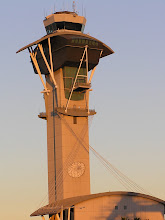
This is how the remotes appear from the tower:


They say that a picture says a thousand words, but in this case that's overkill - six words will do it: We can't see squat out there!
On the other hand, if we had a taller control tower, we could have a better view. Our current tower is about 250 feet (77 meters) tall; this is what we could see if it were 2000 feet (615 meters) tall:

Unfortunately, building us a tower that tall might be considered impractical. But fear not - Technology to the rescue! The airport has provided the controllers with a camera and monitors with which we can see the remote gates, as well as the associated taxiways:


Here's another diagram of the remotes. This is one we use as a quick reference and for training. Like the previous diagram, this one has north at the top. It also shows the gate numbers and their orientation:

Edit: For a revised version of this chart, see this post: Remote Gates, revisited
As you might imagine, the devil is in the details. For those of you who play along at home, here's the backside of diagram, which lists most of the restrictions:

This is how the west remotes are depicted on our ground radar:

International flights regularly park at the remote gates; domestics rarely do. Most of the flights that load and depart from the remote gates occur around noon and midnight, and tend to be trans-Pacific flights. We used to have Central/South American flights depart out of the remotes late at night as well, but that pretty much stopped with the demise of Mexicana. However, most of the aircraft out there have been towed there for storage, usually to wait out a layover. This is the normal procedure if an airplane isn't scheduled to leave right away once the inbound passengers have disembarked. Gates at LAX are at such a premium that an aircraft isn't typically allowed to sit idle at one, especially at the International Terminal. One example is Air China, whose daily flight from Beijing usually arrives between five and six in the afternoon; the return flight doesn't leave until around one the next morning. That's way too long for the airplane to sit blocking a gate at the terminal, so once it's unloaded it gets towed out to the remotes for the interim. These tows can be a burden on the ground controllers, as they tend to be slow (Air China in particular), and may have to move against the flow of traffic. In some cases, it can take thirty minutes to move an airplane from the terminal to the remote or vice-versa. As an aside, I can recall working one of these tows that was really slow: By the time the aircraft made it out to the remote gates, it was time for it to turn around and come back!
 While it's not the primary subject of this photo, the V-Australia B773 on the far right is being towed out to one of the remote gates to spend the day's layover; it'll be brought back around sunset for a 10pm departure.
 This All Nippon B772 is also on its way to the remotes for about a 8-hour layover; it'll depart after midnight.
Some of the domestic carriers also park layover aircraft at the remotes:

The primary domestic users of the remotes for overnight parking are currently mostly tenants of Terminal Three: Alaska, AirTran, Horizon, Jet Blue, and Virgin America. At night, we'll also see Air Canada aircraft moved to the remotes to allow for the wave of late night/early morning Central American flights that operate from Terminal Two; around three in the morning they get towed back to be ready for their sunrise departures.
 A Horizon Dash-8 under tow, on its way to spend the night at the west end
The other reason that an airplane may not be able to depart and ends up at the remotes is because its destination airport is experiencing delays. The airplane may have an expected departure time of an hour or more in the future, but the company needs the gate for other flights. So flight gets loaded and pushes off the gate, whereupon we have to find somewhere on the airport to stash it until it can depart at its appointed time. If it's going to be a wait of more than about fifteen minutes, then the pilots would like to get somewhere they can shut the engines down to conserve fuel. The challenge for the ground controller is to find a place where he can tolerate a stationary aircraft for some extended period of time. Put another way, the ground controller has to make a decision as to what part of his movement area he's willing to sacrifice to accommodate the request.** If it's going to be a long wait, the taxiways around the west remotes are the favorite spot (E-17 in particular), because a parked airplane is least in the way on one of those taxiways (the ground controller can't put an airplane onto a gate just because it happens to be unoccupied at the time - the gates are assigned by LAWA, and nearly all require a ground crew to marshal the aircraft safely into position - thus the ground controller is forced to "store" such aircraft on his taxiways).
The most likely culprit destination airport is San Francisco: Partly due to their weather, and partly due to the close proximity of LA and San Francisco. There's not a lot of airspace between the two cities to hold airplanes, so an airplane departing off either one for the other needs to have a slot in the line available for it. We have similar scenarios with Las Vegas and Phoenix, but since their weather is usually better than ours, the delays tend to be minimal.
Gratuitous aerial views:


* - Cheesy movie reference: The white zone is for immediate loading and unloading of passengers only; there is no stopping in the red zone.
** - Ground Control 101: One of a ground controller's necessary skills is dealing with aircraft that don't have anywhere to go, be it a gate or a destination. While they might like to go park somewhere to wait it out, there are times that the traffic situation just can't accommodate a roadblock. Most times, either ground controller at LAX can absorb at most a couple of airplanes that have to be worked around. There just aren't very many places that we can stick an airplane and leave it there without it blocking something or somebody else. Sometimes the best way is to keep the airplane moving with the flow of traffic so that it doesn't completely block some part of your taxiway. First one way, and then the other. It's like a holding pattern - on the ground!

Special Note: Happy Towel Day!
Tuesday, May 17, 2011
Additions
This is turning into a week of disappointments: I had plans to go to AMVIV, but the scheduling at work has been particularly whack, so that isn't working out. I was intending to mow the yard this morning and then fly to Catalina for lunch (mmm, Buffalo Burgers!), but it's raining in LA today, so that's out too. Of course, I'll take any excuse to not mow the yard, but really - rain in LA in mid-May?! I didn't approve that!
Mind you, it's the perfect excuse for staying inside and eating cookies while writing a blog entry. Too bad there aren't any cookies in the house . . . I'll have to talk to somebody about that. Meanwhile, there have been some recent developments at LAX worth mentioning:
 First is the arrival of two new regional carriers at LAX: Great Lakes Airlines started service here Sunday, flying out of Gate 65 in Terminal 6. They were formerly at Ontario, but reportedly have moved to LAX in expectation of better loads via their codeshare with United. Currently, they fly to Visalia, California, and then continue on to Merced - destinations not formerly served out of LAX. Great Lakes also flies to Prescott, Arizona, a destination that had Horizon service out of LAX for a while last year. Great Lakes (radio callsign: Lakes Air) flies 19-seat Beech 1900Ds. The only other Beech 1900 operator at LAX is Ameriflight, who uses 1900Cs for cargo. Much as I like Beech products, I must say that the D-model is not an aesthetically pleasing airplane, although Great Lakes' paint scheme is one of the more attractive 1900 liveries I've seen:

 Our second new arrival is Mesaba Airlines (radio callsign: Mesaba), who flies 76-seat CRJ9s as Delta Connection out of Terminal 5. We already have SkyWest operating Delta Connection flights using all three CRJ models, and we've heard that Compass Airlines, another Delta Connection operator, will be showing up this summer. So far, I've seen Mesaba flights to/from San Francisco and Salt Lake City. Spotters tips: All the Mesaba aircraft that I've seen so far have registrations ending in "XJ"; many SkyWest aircraft, although not all, have registrations ending in "SK" or "SW", and some of the SkyWest planes may also have "SkyWest" under the cockpit windows.

 While we've had Spirit Airlines at LAX for some time, it's been a while since they were seen here during daylight hours. Spirit has augmented their service to Detroit and Fort Lauderdale with several daily flights to Chicago O'Hare and Las Vegas. I must be feeling snarky today, because I have to say that I like Spirit's old livery (pictured above) much more than the new (seen below). Spirit has also added A320s to their fleet:

Here are a couple of additions to the "Seen at LAX" file:
 This National Air Cargo DC-8 showed up one evening
 Not being a major league soccer fan, I will confess that I'd never heard of the Portland Timbers until this Alaska B737 appeared. Since the LA Galaxy beat them 3-0 when they played here in April, you'd think they'd fly that plane somewhere else . . .
Wednesday, May 11, 2011
Subscribe to:
Posts (Atom)