Thursday, July 22, 2010

LAX aircraft spotters' guide: Boeing 737, Part 2: Classics

Last time, I showed you who brings (or used to bring) B737s into LAX. I mentioned various different models or versions of the B737, denoted by their 'dash' numbers. This time around, we'll start looking at those different models, with some identifying notes. I'm going to skip the -200s because 1) We don't see them at LAX hardly ever anymore - I can't even remember the last one I saw; and 2) I haven't any additional -200 pictures to show you anyway. In this segment, I'm going to look at the models that came after the original B737s (the -100 and -200). This follow-on series of models (the -300/-400/-500) is now referred to as the Classics; these have been replaced by the current production Next Generation models, which we'll look at next time.

B737-300, aka B733


When we're discussing B733s at LAX, we're for the most part talking about Southwest Airlines. Southwest is the predominant operator of -300s at LAX these days, although Continental does show up with one from time to time (2011 update: not any more). Formerly, Frontier and United also had them here (both now have Airbuses instead), as did America West and US Airways. Developed in the early 1980's, the -300 was the first of the second-generation, now referred to as Classic, B737s; the last one was built in 1999. The B733 is nearly ten feet (three meters) longer than the B732 and has a slightly greater wingspan. The most obvious difference, however, is the engines, which are much larger (and more efficient) turbofans. Unlike the original B737s, whose engines were under the wings, the new -300's engines are cantilevered out ahead of the wing. This was done to accommodate the new engine's much larger diameter. Passenger capacity of the B733 is 149 in maximum density configuration, about 20 more than the B732. It used to be that you could tell a Classic B737 from a Next Generation model by the presence or absence of winglets, but no longer. Southwest and Continental have both retrofitted some of their Classic models with winglets; the shots above show one with and one without. In the Next Generation series of the B737, the -300 model has been replaced by the -700 (Continental had and Southwest has both).

With an Air France B777-200

With a Shanghai Cargo MD-11

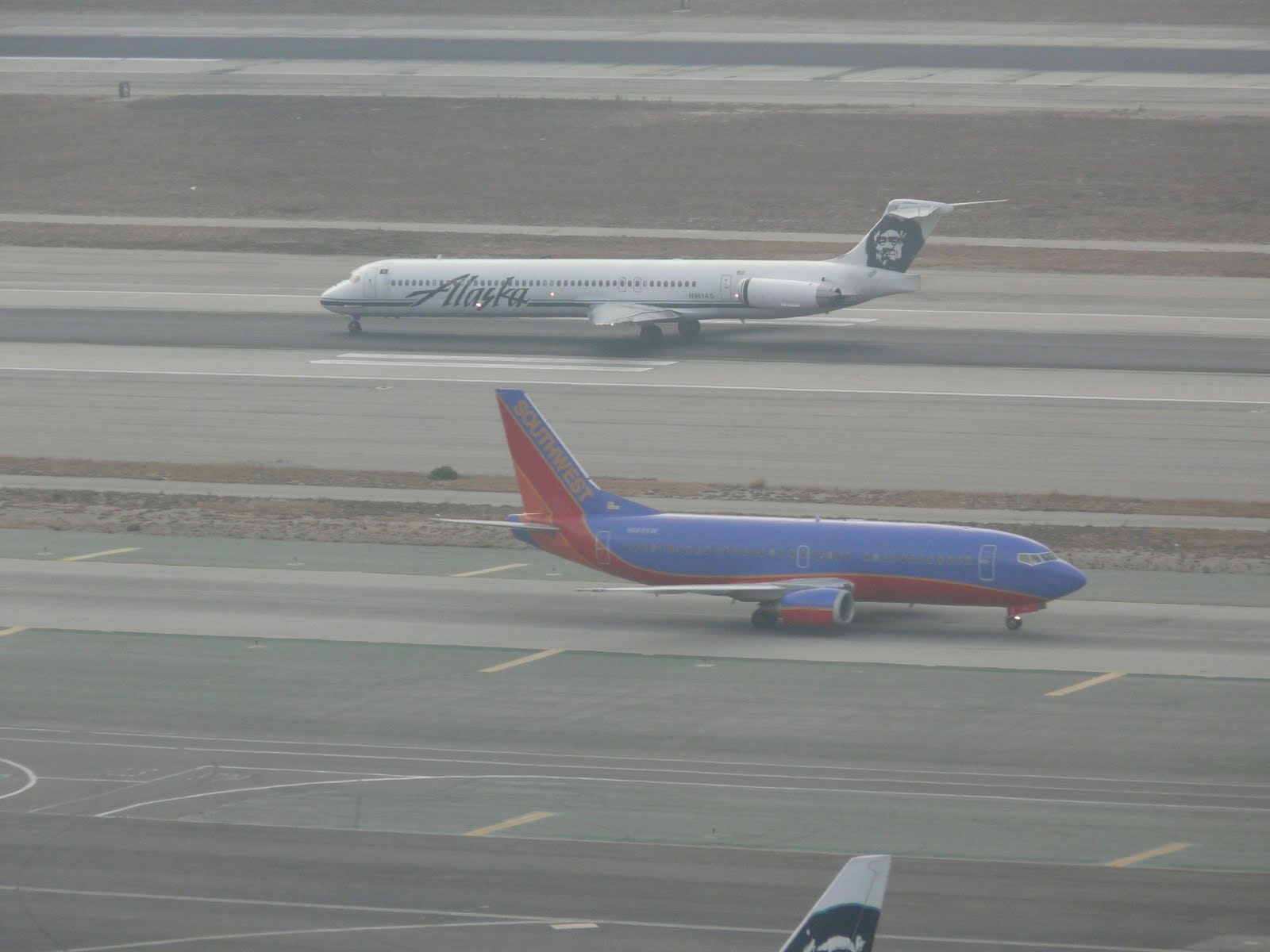
From the archives: With a (now retired) Alaska MD-80

Also from the archives: Two former America West aircraft, now in US Airways colors: At Gate 8, a B733; while Gate 10 hosts an A319

With a British Airways B744

Another from the archives: A United B733 with an Allegiant MD-80

With a KLM B744 (another archive photo - this aircraft is now blue)
(And no, I'm not talking about the heavy jet!)

With a Horizon Dash 8

This is how a B733 looks from a bit further away; in this case going opposite the normal flow of traffic on our new Taxiway Romeo (which we generally use for southbound aircraft) because Taxiway Sierra was closed that day. Seen with an American B738 in the foreground at American maintenance and a Delta A332 in the background on Taxiway AA (that's over a mile from the tower!)


B737-400 (B734)


Just as Southwest is our primary operator of -300s, Alaska is our main -400 operator. In fact, now that I think of it, Alaska is the only regular B734 operator at LAX. The -400 was developed as a stretched -300, and as such is about 10 feet (3 meters) longer with a maximum seating capacity of 168. Besides the longer length, another spotting clue is the pair of overwing exits on each side of the -400; the -300 only has one overwing exit per side. The -400 model was replaced in the Next Generation series by the -800; Alaska has both.


In the next two shots, a Southwest B733 is shown with an Alaska B734:


The similarity between the -400 and its successor, the -800, is seen in the following two photos. The -800's have a five-foot (1.5 meter) taller tail and winglets:


With an Alaska B739, which is longer than the B734 and B738
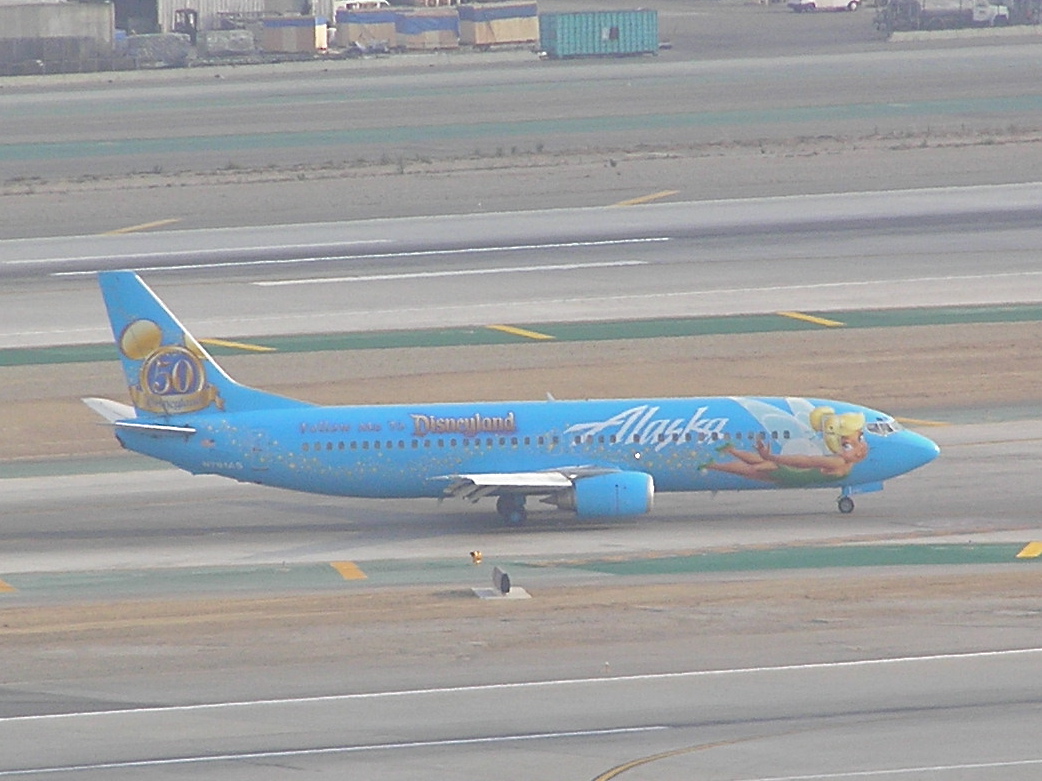
From the archives: With a (now retired, thankfully) American Eagle SF34

With a Northwest B753 (another archive photo; the B753 now flies in Delta colors)

With an Air Canada A319

B737-500 (B735)


The -500 is the smallest of the Classic series models, basically a shortened -300. Almost the same size as the older -200 model, it has a similar seating capacity of 132. United used to have some, and Continental and Southwest still do. Winglets can be retrofitted, and Continental has brought some in that way; I don't think I've seen any Southwest -500s with winglets. In the Next Generation series, the -500 has been replaced with the -600.

It's crazy, but this seems to be the only photo I've got of a Southwest B737-500 by itself; seen here pushing off of Gate 3 for the first flight of the day (hence the oil smoke from the right engine starting up)

A -500 and a -700 together; the -700 on the concrete pad has winglets (and yes, we do call it "the concrete pad" - it's even marked that way on the published airport diagram). Another spotting tip illustrated here: on Southwest aircraft, the stripes on the vertical tail go to the very top tip of the rudder on the -300s and -500s, while they don't make it to the tip of the taller tail on the -700.

With the Skywest 35th Anniversary CRJ9, which at LAX flies for Delta;
Skywest doesn't use CRJ9s for United at LAX (just CRJ2s and CRJ7s)

United -500 and an AeroMexico -700 (from the archives; this was taken back when United still had B737s and AeroMexico still parked at Terminal 5). Note the taller tail on AeroMexico

With an American B757-200

With a Horizon Dash 8 (aka Q400)

This is really an archive photo: Not only does United no longer use B737s, but AeroMexico doesn't have MD-80s anymore, either. This particular one is the shorter MD87

Another oldie: With a Northwest A320

With an Alaska B738 - again, note the taller tail of the newer model

With an American Eagle CRJ7

With a United Express (Skywest) CRJ2

A Continental B735 lifts off from Runway 25 right with an American B763 in the foreground and a Singapore Cargo B744 in the background


Next time around, we'll look at the Next Generation series. It'll be a little while before I get it done, though - I've gotten all bleary-eyed looking at airplane pictures!

Monday, July 19, 2010

LAX aircraft spotters' guide: Boeing 737, Part 1: Operators (revised)


I started the LAX aircraft spotters' guide series last year, and while I meant for it to be an occasional feature, I didn't intend for it to be so long before continuation. Last time, we looked at the Airbus 330, a subject that now deserves an update, perhaps later in the series. This time, we'll go from a relatively uncommon (at LAX, anyway) model to one that has to be ubiquitous: the Boeing 737. Possibly best known as the mainstay of Southwest's fleet, the B737 has appeared in the colors of too many airlines to even count. Some carriers at LAX used to have B737s that have since been phased out in favor of something else, while others have gone from something else to B737s. I'll be dredging through my archives to show you as many different B737 carriers and liveries as I can find.

There have been more Boeing 737s produced than any other model of airliner: over 6,000 to date, with over 2,000 more on order; it's the best-selling airliner of all time. Originally developed as a shorter-range and smaller capacity alternative to the B707 and B727, the B737 has outlived them both. Since first flown in 1967, the B737 has grown into a trans-continental and ocean-crossing mainstay of the airliner fleet. There are many sub-one-hour B737 flights out of LAX, primarily to Las Vegas, Phoenix, and the Bay Area (Oakland, San Francisco, San Jose). At the other end of the range, our longest B737 flights run five to six hours: Anchorage, Boston, Honolulu, and Panama.

We regularly see seven different models of the B737 at LAX: The -300/-400/-500 models, known as the "Classic" series; and the current-production "Next Generation" -600/-700/-800/-900. It's been quite some time since I've seen an original -200 here. Within each model there are additional versions, such as cargo or combi, extended range or long range; most of these are invisible to ATC, and I don't try to keep track of them.

The B737 will be a mini-series within the spotter's guide series; I'll start this time with a roster of current B737 operators at LAX:

American operates B737-800s, which are gradually replacing the MD82s and MD83s

AeroMexico brings in mostly B737-700s like this one, with an occasional -800

AirTran (callsign: Citrus) uses B737-700s

Alaska has B737-400s, -700s, -800s, and -900s; seen here is a -700 taxiing in with a -800 on departure

Continental has the greatest variety, with -500s, -700s, -800s, and -900s; these are both -800s

Copa brings in -800s (and new at LAX this weekend, a -700)

Delta has B737-800s, seen here in new and old liveries

Southwest has -300s, -500s, and -700s; blue is a -500, gold is a -700

Sun Country uses B737-700s and -800s; this is a -800

WestJet has -600s, -700s, and -800s; this one is a -800


And now some former B737 users at LAX:

Aviacsa was a Mexican carrier that disappeared from LAX several years ago; they were the last scheduled operator here to use B737-200s like this one. Compare the long, skinny engine cowlings to those on all the newer models; this model used more fuel and made much more noise and smoke than its replacements. In addition, while the engines on these older models were under the wings, newer models (such as the one in the next photo) have their engines mounted ahead of the wings.

United phased out its B737s last year; their last one, a -300, passed through LAX on its final revenue flight. This one is a -500

US Air rarely brings B737s into LAX anymore; this shot was taken about two years ago. This -300 still flies for US Air, though; previously it was with America West


We don't just see B737s in airline colors; the BBJ (Boeing Business Jet) is a corporate version of the B737. Most of these appear to be BBJ1s, which are based on the -700; but there is also a -800 version, known as the (wait for it) BBJ2. And of course, some are simply converted airliners (which is how Boeing got the idea in the first place, as has Airbus; It works the other way, too: today's regional jets have their roots in business jets). Unlike airlines, whose aircraft serve double duty as really expensive portable billboards, corporate jets tend to be very low-key; hardly ever is there any indication of who they fly for.

This is what a brand-new BBJ looks like. Unlike the airliner models, which tend to leave the factory fully finished and ready (or nearly so) to enter service, the corporate versions often leave as "green" aircraft, lacking paint and interiors. They then go to another facility, known as a completion center, for these finishing touches. This aircraft showed up over the weekend, and was one of the motivations for revising this edition.

Wednesday, July 14, 2010

World Cup

Although we've got David Beckham on strength with the Los Angeles Galaxy (LA's Major League Soccer team), soccer just doesn't get as much play in the US as it does in most of the rest of the world. Many of us played as kids, but somehow it still isn't as nationally prominent as baseball, basketball, and American football. Even so, we did hear a little something about Spain's victory over the Netherlands after extra time (what we call 'overtime' in the US) - Spain's first World Cup win. To my Spanish readers: ¡felicidades!

I can't show you any Spanish airlines because we haven't any at LAX (although I think we used to have Iberia a good while ago). However, there happen to have been a couple of soccer-related liveries pass through LAX recently, and this seems a good time to display them:

JetBlue is the official airline for Real Salt Lake, the Major League Soccer team in Salt Lake City, Utah. It's funny this aircraft being at LAX, since JetBlue doesn't fly from LAX to SLC. In their most recent meeting last month, Real Salt Lake broke the Galaxy's undefeated streak 1-0. I took this shot a couple of weeks after that game. Maybe not so funny after all . . .

Australia's bid to host the 2018 or 2022 World Cup is, not surprisingly, supported by Qantas. Reportedly, their 2018 bid has since been withdrawn in order to focus on 2022.

References:

JetBlue

Wikipedia

Tuesday, July 6, 2010

Wake Turbulence: Part 5: Pilot Actions


This is the fifth segment in a series on wake turbulence, originally inspired by a reader's question. I've been meaning to get back to this series for quite some time now, as there's one more part to the story.

Earlier on, in Part 2, I discussed the obligations that air traffic controllers have concerning wake turbulence. If you like, you may revisit it here:


But controllers are only half the story; pilots also have their own role. Outside of the controller regulatory stuff, most of my reference material for this series has been pilot training information.

When I was going through my flight training, we discussed wake turbulence avoidance, particularly when training flights began to take us into airports where larger aircraft operated. Since the wake of the aircraft ahead of you is normally invisible, the pilot has to be aware of where the previous airplane is (and was), and fly his plane outside of where the wake vortices are anticipated to be. That sounds easy enough, since the vortices normally spread out from the wingtips and descend below the generating aircraft. But how does the following pilot ensure that his flight path is not below that of the aircraft ahead?

The standard recommendation is for the following pilot to set up his approach to the runway slightly above the normal glidepath, and then land further down the runway than the larger aircraft ahead. As I mentioned in the opening segment in the series, the vortices are caused by a wing that is creating lift. Once the wing stops lifting, the vortices are no longer being generated. So the following pilot aims to touch down beyond the point on the runway where the preceding aircraft landed.

This group of photos shows two successive aircraft arriving on Runway 24 Right. First, we see the heavy B767; note the touchdown point in relation to the glideslope shack and antenna between the runways:


Now, observe the glide path of the succeeding Beech 1900, a considerably smaller aircraft; the pilot deliberately lands well past the point where the heavy jet touched down:


Of course, it isn't always that easy. The runway doesn't go on forever, so the pilot can't let too much of it go past; he's still got to have room to get his own craft on the ground and stopped. That's why we have increased spacing for a smaller aircraft following a large one; it allows time for the heavy jet's wake vortices to spread out away from the runway and begin to dissipate. Generally, the further behind the preceding aircraft you can be, the better your chances of avoiding a wake encounter.

Besides staying above it, another thing a pilot can do to avoid the wake from a preceding aircraft is to fly upwind of the other aircraft's flight path. To do this, the pilot will need to be aware of the wind direction at his altitude, which he certainly should already know. This is just like sitting upwind of a campfire; you let the wind blow the smoke (or wake vortices) away from you. If the wind shifts, you'll have to move your seat to a different spot (or adjust your flight path to the other side of the course or airway). Just like putting extra distance between you and the aircraft ahead, this technique can be applied enroute as well as in the approach-to-landing phase of flight.

Despite a pilot's best efforts to stay away from the wake of another aircraft, it can still happen. In busy terminal areas or at airway intersections, especially. For this reason, most airline pilots (and many charter pilots) receive what is known as upset training. While this used to have to be done using aerobatic aircraft, today's full-motion simulators are capable of offering the training without ever leaving the ground. The training consists of learning how to recognize and recover from sudden, uncommanded unusual attitudes, such as may result from an aircraft getting caught in the wake of another, particularly larger, aircraft. In preparation for this segment, I conducted an informal poll of air carrier pilots on the ground at LAX one Saturday afternoon. Pilots for every US carrier I asked told me that upset recovery is part of their regular recurrency training and sim rides.